There is a box on the Turkish listing portals marked sahibinden, and the word does two jobs at once. Sahibinden means "from the owner"; Sahibinden.com is also the name of the country's largest listing site. So a Turkish seller who says they are selling sahibinden means they are selling without an agent, not that they are selling on one particular website.
Ask an estate agency whether you need an estate agency and the answer is not hard to predict. The honest version is still worth writing, because selling without one genuinely is right in certain situations, and choosing not to pay a fee is a legitimate choice. What changes the arithmetic, if you are reading this from London or Dubai or Singapore, is that one entire column of the ledger is unavailable to you at any price: your own presence in Istanbul. That does not settle the question. It moves where the question sits.
Start with what distance actually blocks
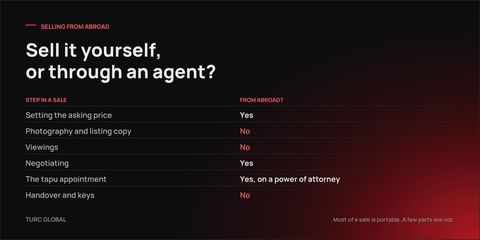
Most of a sale is portable. A few parts are not, and mixing the two is how owners abroad commit to a plan that quietly depends on a favour from a relative.
| Step in a sale | Can you do it from abroad? |
|---|---|
| Setting the asking price | Yes, if you can get completed-sale data rather than asking prices |
| Photography and listing copy | No. Somebody has to be inside the flat with a camera |
| Fielding enquiries | In theory. Most arrive in Turkish, on Istanbul hours |
| Viewings | No. Somebody opens the door, repeatedly, at the buyer's convenience |
| Screening buyers and their finance | Partly. A mortgage valuation needs access to the flat |
| Negotiating | Yes, by phone or message |
| The tapu (title deed) appointment | Yes, on a properly drafted power of attorney |
| Handover, keys, utility transfers | No |
The power of attorney is the good news, and the piece that surprises owners most: the transfer itself can be completed without you flying in. What the document must say, and why a general power will not do, is set out in selling your Istanbul property from abroad.
The rows above it are the problem. For a non-resident owner, "selling it yourself" is rarely selling it yourself; it is selling through whoever holds your keys, which usually means a sibling, a cousin or the building caretaker. That can work well. Before you build a plan on it, check that the person has understood what they are agreeing to. Viewings are not one afternoon. They are months of Saturdays, and a fair share of the people who book will not turn up.
When selling it yourself is genuinely the right answer
This section is not a courtesy. In most of the following cases you do not need an agent, and an agency is telling you so.
- The buyer already exists. A neighbour, a relative, a co-owner who wants your share, your own sitting tenant. With no marketing to do, what an agent adds shrinks to the paperwork, and you can buy that piece alone.
- You are not really absent. You come to Istanbul often, or family in the same building is genuinely willing. The most expensive item on the list is nearly free for you.
- You track completed prices, not asking prices. You have bought and sold in the district before and you are comfortable being haggled with.
- The property is in the easy segment. Clean paperwork, iskan (occupancy permit) in order, a well-priced flat near a metro line needs far less handling than a problem title.
- You are in no hurry. A slow sale will not put you under financial or emotional pressure.
If most of that describes you, sell it yourself. Two things are still worth an outside eye: the price, and how the money will move. An owner who prices wrong loses several times any fee in months of staleness, and a free valuation costs nothing and commits you to nothing. The decision stays yours.
The costs that never arrive as an invoice
Pricing error is the big one. Expectations built from asking prices sit above what the district is actually closing at. The listing goes stale, and the discount you eventually take is larger than the fee you avoided. The opposite error hides better: a flat priced too low sells on the first day, and the seller reads that as success.
The phone traffic is mostly not buyers. Neighbours benchmarking their own flat, people fishing for the address, hagglers who want to negotiate before seeing anything, agents hunting stock. Filtering them is invisible work. Across a time difference, in a language you may not speak, it is worse than invisible — it is slow, and slow reads as disinterest to a real buyer.
You negotiate alone, against someone who does not. The buyer usually arrives with their own agent, their own lawyer or simply their own experience. You are the emotionally attached party, on the wrong continent.
The closing is where a mistake costs most. The buyer's mortgage and its valuation, the price declared at the deed, how the money actually moves, the renegotiation attempted at the registry counter on the day. Errors here are rare and expensive, which is the worst combination for a first-timer.
Side by side
| Item | Yourself | With an office that does the job |
|---|---|---|
| Fee | None | Nothing up front; arises only on completion |
| Pricing | As good as your own research | Built from completed sales |
| Viewings | Someone must be there, every time | Run for you |
| Buyer screening | Down to instinct | Budget and finance checked first |
| Negotiation | You, directly | A third party absorbing the pressure |
| Paperwork and tapu | Your own risk | Managed to the appointment |
| Your time | All of it | Most of it delegated |
On the fee: nothing is payable up front, it arises only if the property actually sells, it sits within the statutory ceiling set by Turkey's property trade regulation, and unless the contract says otherwise it is split equally between buyer and seller. The full framework, including what a written service agreement must contain, is in estate agent commission in Turkey.
What you should be getting for it
Before the listing
Pricing reasoned from comparable completed sales; a check on the title and the missing documents behind it (iskan, annotations, compulsory DASK earthquake insurance); honest advice on which repairs are worth making; professional photography.
While it is on the market
Buyers screened for budget and finance before they are given a viewing time; viewings run without you; written reporting that reaches you in a usable form across the time difference; the property put to the office's own buyer register and to other agents, not only to a portal.
At the deed
The buyer's finance and valuation chased, a payment structure that protects you, and the tapu appointment, the harç (deed transfer tax) calculation and transfer day organised.
If you are getting all of that, the fee is the price of a service. If you are getting half of it, you were right to sell it yourself. Choosing the right office matters more than choosing to use one at all — a bad agency produces a slower and more expensive outcome than doing nothing.
Choose on evidence, not on the number you are quoted
Be wary of the office that wins your instruction by quoting the highest figure. The listing sits, the price comes down in stages over the following months, and you arrive where a realistic figure would have put you at the start — only with a stale advert. The right office is not the one that says the biggest number; it is the one that can show you why its number is the number.
Ask directly: how many properties like mine have you sold in this district in the last year? Is your figure based on asking prices or on completed sales? What is the plan beyond putting it on a portal? How often will you report, and how do you handle a client in another time zone? What is the term of the agreement, and how do I get out of it? Then ask for the firm's Taşınmaz Ticareti Yetki Belgesi, the real estate trading licence, and its number.
One formality follows the decision: Turkish law does not let an agency advertise your property until you have authorised it through the state e-Devlet portal. It takes a couple of minutes, costs nothing, and you can withdraw it whenever you like — the screens are shown on our listing authorisation page.
It does not have to be all or nothing
Plenty of owners land in between: running the listing themselves but taking advice on price and on the contract, or handing over marketing and viewings while keeping the negotiation. The same calculation in its letting version is in letting yourself or using an agency.
The useful question is not "should I pay a fee?" It is: of the jobs on this list, which can I genuinely do from where I live, and who is doing the rest? An owner who answers that honestly will make the right call either way. An owner who leaves half the list blank pays for it later, whichever route they chose.