"There's no rush — let it find its true value." We hear that sentence a lot, and for owners living abroad it is even easier to say: the apartment is far away, the listing can wait another month. It sounds prudent. It is usually the most expensive decision available, because an empty apartment's meter keeps running while you wait. The lost rent never comes back, and the aidat (the building's monthly service charge) and taxes keep getting paid.
In this guide we put the feelings aside and do the arithmetic. Swap in your own numbers — the logic stays the same and always arrives at the same question: is waiting actually earning you anything?
The visible loss: uncollected rent
Start with the simplest line. For an apartment that could bring in ₺40,000 a month, every empty month is ₺40,000 of income that was simply never collected. This money is not "made up later". An apartment that sat empty for three months cannot charge the next tenant a three-month premium. The daily figure is what makes it vivid: roughly ₺1,300 leaves the account every single morning, without anyone being asked.
And the loss is not only the rent. An empty apartment keeps generating costs:
- Aidat: in a managed complex, the monthly charge comes out of the owner's pocket whether anyone lives there or not. In complexes in Başakşehir and Beylikdüzü, ₺2,500–6,000 a month is ordinary.
- Property tax and compulsory insurance: DASK (compulsory earthquake insurance) and property tax accrue even when nobody is home.
- Standing charges and upkeep: small bills that continue, airing the flat against damp, interim cleaning.
- Wear from neglect: an unused apartment goes stale; damp and plumbing issues in long-closed flats knock money off at viewings.
In numbers: a ₺40,000 rental left empty
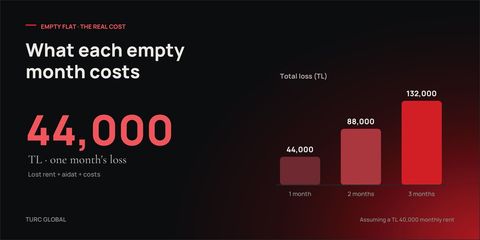
For a complex apartment with a ₺40,000 rent expectation and ₺3,000 aidat (we set aside ₺1,000 a month for tax and small costs), the table looks like this:
| Time empty | Lost rent | Aidat paid | Tax & other costs | Total loss |
|---|---|---|---|---|
| 1 month | ₺40,000 | ₺3,000 | ₺1,000 | ₺44,000 |
| 2 months | ₺80,000 | ₺6,000 | ₺2,000 | ₺88,000 |
| 3 months | ₺120,000 | ₺9,000 | ₺3,000 | ₺132,000 |
The table's message is blunt: an owner who waits three months has erased roughly three and a half months of rent. To claw that back, the next tenant would have to pay ₺11,000 a month over market for a full year, and the market will not allow it.
Building your own table is simple: monthly rent expectation plus aidat plus a monthly share of tax and costs, multiplied by the number of empty months. Write that figure down; every pricing decision below should be compared against it.
The real question: "₺5,000 more" or "a tenant now"?
Now set up the classic dilemma with numbers. You have two options:
- Ask ₺45,000 and wait. Being above the market, the apartment plausibly sits empty for 3 months. First-year income: 9 months × 45,000 = ₺405,000, minus three months of aidat and costs ≈ ₺393,000
- Let at ₺40,000 in the first month. First-year income: 12 × 40,000 = ₺480,000
The difference is ₺87,000 a year (nearly two months of rent), and the "higher price" side is the one that loses. In the first year, a 12.5% higher rent never recovers a three-month void. Over a longer tenancy the gap narrows, because the higher rent is also the base for every capped increase, though less than plain sums suggest once inflation is counted; the lower-the-rent-or-wait calculator shows where the break-even falls for your own figures. The rough rule for a one-year let: pricing 10% above the market is not worth risking more than a single month of vacancy.
Opportunity cost: where the money sits idle
There is also an invisible layer. Every ₺40,000 you failed to collect was money that could have been earning a return in a deposit account or elsewhere. In a high-inflation environment the effect compounds: rent not collected today buys a little less every month that passes.
The same question applies to the apartment itself. A flat worth ₺6,000,000 producing ₺40,000 a month has a price-to-rent multiple of 150 months — a sign the investment is in a reasonable band. If the apartment keeps sitting empty, the effective multiple deteriorates, and "keep this flat, or sell and redeploy in a better district?" becomes a legitimate question. Run your own numbers through the rental yield calculator.
The exceptions where waiting makes sense
To be fair, there are cases where waiting is the calculated move, but they are justified by a calendar, not by a feeling.
If a renovation that will genuinely raise the rent is planned (a bathroom refit, a boiler conversion) and its duration and cost are known, a few weeks' delay is a sensible investment. The same rule applies even here: the renovation's contribution to the rent should pay back the empty weeks plus the cost within two to three years.
Season can also be a legitimate reason. For an apartment that empties in mid-December, targeting early February (and using the quiet weeks for paint and cleaning) beats cutting the price into January's stagnation. The difference is this: an owner waiting deliberately has an end date; an owner waiting hopefully does not.
"I'm waiting for the right tenant" only holds while there is candidate traffic. Holding three to five viewings a week and being selective is healthy. When the phone never rings, the problem is invisibility.
Three ways to shorten the void
If the mathematics of the loss is this clear, so is the remedy: shorten the empty period.
- Price from data. Look at completed lettings, not asking prices; the first two weeks of a listing draw the most demand, and the right price is what catches that window.
- Show the apartment ready. Paint, cleaning and bright photographs mean more of the people who view go on to make an offer.
- Don't let the process idle. Return calls the same day, batch the viewings, have the paperwork prepared in advance.
If the apartment still will not let, the causes usually trace to a handful of fixable issues: pricing, presentation and availability for viewings. An owner abroad struggles most with the third one, which is exactly the case for handing the process over. How that works in practice is described in our guide to property management for remote owners.
Use the predictability of a departure, too: if your current tenant has given notice for two months' time, put the listing live 3–4 weeks before the exit date and plan viewings with the tenant's agreement. Cutting the gap between two tenants to a single week is worth the same as a month of rent every year.
Waiting has a price tag
Waiting is not a neutral act; as the table shows, it is a ₺44,000-a-month decision. The right question is not "could I get more?" but "can I get enough more to cover every month I spend waiting?"
If you want to know your apartment's realistic rent band today, ask for a free valuation: it puts current district lettings on the table, and a plan for keeping the empty weeks to a minimum.