If you own property in Turkey and this year's property tax notice looked several times larger than last year's, nothing has gone wrong with your file. 2026 is a reassessment year (the exercise Turkey runs once every four years), and the street-by-street land values it produced will stay with you until 2029.
The part that made the news is that parliament capped the increase. How large that cap actually is depends on how one sentence is read, and two different figures circulated in the Turkish press. Below: why the jump happened, what the cap really works out to, and two quieter changes that matter more over the next three years than the cap does.
Why the bill jumped: the reassessment year
Turkish property tax (emlak vergisi) is not calculated on what you paid for your flat. It is calculated on the tax value in the municipality's register, and that value has two parts: a building value, derived from construction cost figures published annually, and a land-share value, based on per-square-metre unit values that assessment commissions set once every four years, street by street.
Those commissions did their work during 2025 and published the land unit values for the 2026–2029 period. In the three years between reassessments the values are only indexed; the jump happens precisely in years like this one. On many Istanbul streets the new unit values came out at several times the old ones, especially in neighbourhoods that gained a metro line, an urban-renewal scheme or a major new development in the last four years.
The statutory cap: what "two times more" means
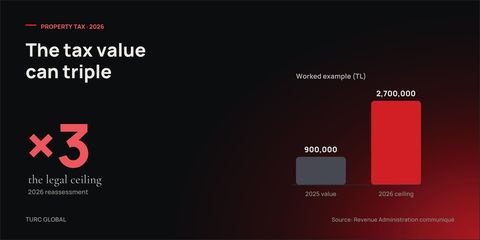
To limit the shock, Law No. 7566, published in the Official Gazette on 19 December 2025, added a ceiling to the Property Tax Law. The rule it creates: the building and land tax value calculated for 2026 cannot exceed "two times more than" the 2025 tax values.
That phrase is the trap. The change was widely reported as "increases capped at double". But twice and two times more than are not the same thing in Turkish statutory language: the second means the existing value plus two times that value, three times in total.
There is no need to argue the reading, because General Communiqué No. 89 on the Property Tax Law, published in the Official Gazette on 31 December 2025, works the arithmetic through with an example:
| Example from the Communiqué | |
|---|---|
| 2025 tax value | ₺900,000 |
| Cap calculation | 900,000 + (900,000 × 2) |
| Maximum value applicable for 2026 | ₺2,700,000 |
So even if the post-reassessment calculation produces ₺6,000,000, the value used for that taxpayer in 2026 stops at ₺2,700,000. The ceiling is three times the 2025 value.
Stated plainly: this is a brake, not a discount. Your tax value can still triple against 2025, and at metropolitan rates that means your property tax bill can very nearly triple too. The cap only trims the extreme cases that would have gone four or five times higher.
The same logic applies to anyone becoming liable for the first time in 2026: a new purchase, a handover from an urban-renewal project, a subdivision or merger of plots. The unit value used cannot exceed two times more than the unit value applied in 2025.
The quieter change: the interim-year formula
A second change got far less attention than the cap, and its effect will be felt every year from 2027 onwards.
Under the old rule, in the years when no reassessment takes place, the tax value was increased by half of the revaluation rate announced for that year. Law No. 7566 removed the words "half of" from Article 29 of the Property Tax Law. In interim years, the full revaluation rate now applies.
In numbers: the revaluation rate announced for 2025 was 25.49%. Under the old rule that meant roughly a 12.7% increase in the tax value; under the new rule the same rate passes through in full. The annual pace of increase in interim years has roughly doubled.
The 2027, 2028 and 2029 values will each be produced by applying the revaluation rate to the (capped) 2026 value. Note what that means: the cap applies once, and the following three years then compound from this new, higher base.
A third change runs in the owner's favour: the discretionary power to raise tax values has been removed. The upper limit on increases is now set directly by statute rather than by an administrative decision.
How to check your own bill
Before accepting the new notice as simply "what came", do a two-minute check.
1. Find out your own tax value. Ask your municipality's property department, or use its e-belediye portal, for both your 2025 and your 2026 tax value. The comparison is between those two figures, not between last year's and this year's payment.
2. Calculate the cap yourself. Multiply your 2025 value by three. If your 2026 value is above that figure, the cap has not been applied correctly. And that is not a matter for debate. It is an error to be corrected.
3. Verify the register details. Four items determine the whole calculation: gross square metres, construction class, building age and land share. This is exactly where correctable mistakes sit — a recorded area that does not match the title deed, or a building age that has not been updated in years. Where there is a factual error, a written correction request goes to the municipality, and the reassessment itself never has to be argued.
4. Watch the clock. The period for challenging an assessed tax before the tax court is generally 30 days, and it does not come back once missed. The right to challenge the assessment commission's decisions themselves belongs to bodies listed in the law; an individual owner's route is through their own assessment. If the amount is material, take it forward with an accountant or a lawyer.
The rates themselves did not change: within metropolitan boundaries, 0.2% on residential buildings, 0.4% on other buildings, 0.6% on building plots and 0.2% on agricultural land, plus a contribution to the protection of cultural property equal to 10% of the property tax. Instalments remain March–May and November.
The tax value drives more than the property tax
The real significance of this year's increase is less the figure itself than everything else it touches. The tax value is the shared floor under several items that look unrelated:
Title deed fee. The price declared at the land registry on a sale cannot be below the municipality's tax value. Since tax values have risen, the minimum fee payable on the same flat has risen with them, and the penalty for under-declaring quadrupled at the start of 2026, which we cover in declaring the real sale price at the title deed.
Valuable housing tax. The 2026 threshold is ₺17,711,000. What is measured against that threshold is not market value but precisely the building tax value that jumped this year. Since tax values can triple, some homes that were nowhere near this tax last year may now be close to the threshold. When you learn your new value, compare it against this figure too.
Inheritance and transfer tax, stamp duty and expropriation calculations all draw on the same base.
Your rental yield. Property tax is one of the items deducted on the way from gross rent to net. For owners using the actual-expense method it is deductible; under the lump-sum method it comes straight off your net return. We compare the two methods in our rental income tax guide, and the rental yield calculator will show you where your own property sits in a couple of minutes.
Who is hit hardest
What we see on the ground is that the jump tracks the land share, not the price of the property. That produces a counter-intuitive result.
| Property type | Impact | Why |
|---|---|---|
| Large flat in an old, low-rise building | Highest | Large land share, building value eroded by age |
| Flat in a new, high-rise complex | Moderate | Small land share; building value high but indexed |
| Empty building plot | Highest | The value is entirely land, and the rate is 0.6% |
| Let commercial unit | High | 0.4% rate, plus the land-share effect |
So it is not the flat in the newest building on the street that sees the sharpest rise. It is the large apartment in the forty-year-old block on the corner. Two flats of identical size on the same street can now carry very different bills for this reason.
A new floor, not a one-off shock
The importance of 2026 is not in a single year's bill. The value set this year becomes the base for every year until 2029, and that base will now grow faster, at the full revaluation rate. Your cost of holding the property has moved up permanently.
The work, in order: put your 2025 and 2026 tax values side by side, verify the cap by multiplying by three, check the four register items, and if there is an error, apply within the deadline. Most files complete those four steps without needing a lawyer.
For owners abroad, one practical note: these notices go to the property's registered address and the municipality, not to you. If nobody is opening your post in Turkey, the first you may hear of an error is when late-payment interest has already accrued — one of the routine things a property manager handles on your behalf.
A higher holding cost reopens the hold-or-sell question for some owners. Before deciding, you need to know what your property is worth today on comparable evidence, which is what a free valuation is for. Put the yield and the holding cost side by side and the picture is often different from the one you assumed.