Two owners asked us the same thing this month, from two different continents: "We understand what DASK is. How do we actually do it from here?"
It is a fair question. Every guide to owning property in Turkey says the earthquake policy is compulsory and the owner's responsibility, then stops. None of them tells you which screen to open, what number the form will ask for, how to find out whether a policy already exists, or what you lose if you miss the renewal. This article is only about the procedure. What DASK covers, what it excludes and why loss of rent is not in it, we explained in DASK: why your tenant can't get electricity without it.
One warning before the steps. From 5 September 2026 the policy no longer passes to the buyer when a property is sold. It ends automatically on the day the title is transferred. If you bought recently, or are about to sell, the section on that rule is the most important part of this page.
What to have on the desk before you start
With the right information in front of you, a policy takes about twenty minutes. With one item missing it drags on for days, so complete this list first:
| Item | Where to find it |
|---|---|
| Title deed details: province, district, neighbourhood, ada (block), parsel (plot), bağımsız bölüm (unit number) | Printed on the tapu; e-Devlet "Tapu Bilgileri Sorgulama" if you have access |
| UAVT address code (adres kodu, ten digits) | DASK's own address-code lookup on dask.gov.tr; e-Devlet "Adres No Öğrenme"; the building manager; any insurance agent |
| Gross floor area (brüt m²) | Not on the title deed; the building's management plan or the site (gated complex) management office |
| Construction type (reinforced concrete, masonry, other) and number of floors | The building permit; site management; usually auto-filled from the address code |
| Construction / permit year | The building permit; the municipality's planning office; site management |
| Identity number: a Turkish ID number, or for foreigners the yabancı kimlik no (starts with 99), a tax number (vergi no) or a passport number | Your residence card or passport; a tax number is issued by any tax office against a passport, on the spot |
| E-mail and phone | The policy arrives as a PDF by e-mail; notifications by SMS |
The item owners abroad most often lack is the address code. Since 2013 no DASK policy can be issued without this ten-digit number, and most foreign owners have never heard of it. It is printed on any electricity or water bill for the flat; failing that, DASK's own lookup tool finds it from province, district, neighbourhood, street and door number.
The second is gross floor area. The sum insured is calculated directly from it, so "roughly a hundred" is the same as accepting a smaller payout after a loss. If you do not know it, ask the site management in writing. Confirming a unit's floor area with the site office is one of the routine things we do for owners who are not here.
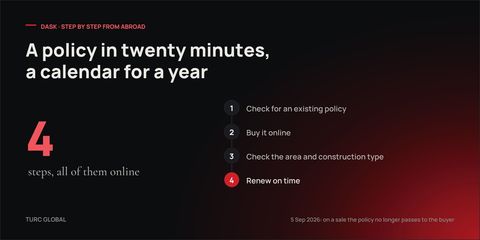
Step 1: Is there already a policy, and when does it end?
Most owners do not know, because the policy was bought by the previous owner or by a tenant and nobody tracked the date. There are three ways to find out:
- The policy query on dask.gov.tr. No login. Enter the address code together with your Turkish ID, foreign ID or tax number; there is also a tab that queries by passport number alone. The result shows the insured's name, the issuing agent, the building data, the sum insured and the start and end dates. For an owner abroad this is the practical route.
- e-Devlet. Under "Doğal Afet Sigortaları Kurumu" you will find policy query, claim notification and claim tracking. It only shows policies in the logged-in person's name, and you need a foreign ID number to hold an e-Devlet account at all, which is why the first route is broader.
- Alo DASK 125. The call centre answers from within Turkey; from abroad, your manager or agent can call on your behalf.
If the query shows the policy in someone else's name, there are two cases. If you bought before 5 September 2026 and the policy is still in the seller's name, tell the insurer and have it endorsed into yours; there is nothing to gain by waiting. If your tenant bought it in their own name, that is fine: DASK distinguishes the person who buys the policy (sigorta ettiren) from the owner (sigortalı), and compensation is always paid to whoever holds the title deed.
Step 2: Where to buy it
The Turkish Catastrophe Insurance Pool does not sell policies itself. Every insurance company, agent and bank branch issues DASK on its behalf; the cover and the premium are fixed by tariff and identical everywhere, so the only difference between channels is convenience:
- Insurers' and agents' websites. You enter the ID number, the address code and the building data, the premium is calculated on screen, you pay by card and the policy PDF arrives by e-mail. You do not need to be in Turkey.
- Comparison sites. The same flow, showing several insurers. Because the premium is fixed by tariff there is no "cheapest DASK"; the benefit is finishing on one screen.
- Turkish banking apps. If you have a Turkish bank account, most apps issue a policy from their insurance menu in minutes and debit the premium.
- Through an agent, remotely. You send the details by e-mail or message, the agent issues the policy, you transfer the premium. For owners without a Turkish account, or whose foreign card is refused, this is the safest route.
e-Devlet does not sell DASK. It hosts only query and claim services; anyone who "bought DASK on e-Devlet" was redirected to an insurer's site.
One note for buyers abroad: whether a foreign-issued card is accepted depends on the seller's payment gateway, and no official source addresses it. If your card is declined, nothing is wrong with your policy application. Go through an agent and pay by transfer.
Step 3: What to check on the form
Most fields fill themselves from the address code. Three things are yours to verify:
Are the floor area and construction type right? The sum insured is DASK's per-square-metre rebuild cost, re-indexed to producer prices every month, multiplied by the gross area, up to a ceiling. In the October 2026 tariff:
| Item | October 2026 value |
|---|---|
| Unit cost per m², reinforced concrete | ₺12,039 |
| Unit cost per m², other construction | ₺8,026 |
| Maximum sum insured on any one policy | ₺2,552,268 |
So a 100 m² gross reinforced-concrete flat is insured for about ₺1,203,900. Understate the area and you understate the payout. The figures change on the first of every month, so look at DASK's own tariff page when you buy; the cover on a policy already in force rises with the index automatically, at no extra premium.
Why is the premium different from your neighbour's? The premium is a per-mille rate on the sum insured, and the rate depends on the building's earthquake risk group (seven of them) and its construction type. Most of Istanbul's densely built districts sit in the two highest groups. Three adjustments follow: +10% for buildings permitted before 2000, −10% for buildings of three floors or fewer, +10% for eight floors or more. By DASK's own example, a 100 m² concrete flat costs a few thousand lira a year in the riskiest group and about a quarter of that in the safest. Against a year's rent the premium is trivial. What owners neglect is not the premium but the calendar.
Who is the applicant, and who is the insured? Someone else can buy the policy for you: your tenant, the building manager, or a property-management office like ours. No power of attorney is needed, only your identity and title details. The insured field must carry the owner's name. Where the title is shared, one policy is issued per unit and compensation is paid to all title holders in proportion to their shares, whoever paid the premium. If two co-owners live in two countries, as with one family we advised recently, one of them can buy it for both.
Step 4: Renewal and the 20% discount
The policy runs one year and renewing it is the owner's job; the insurer reminds, it does not renew. Under the tariff, a policy renewed within 30 days after expiry is priced with a 20% discount. After thirty days the discount is lost and a fresh policy is issued. Renewing before expiry, quoting the old policy number, is also possible and is the cleanest way.
Two calendar rules we recommend to owners abroad:
- Put the renewal date next to your letting dates. A policy that ends in August and a lease that starts in September means a tenant who cannot open the electricity account; that story is in the DASK explainer. Add the expiry date to the checklist you run when a tenant moves out.
- If you own several flats, align them. Scattered renewal dates are the single most common reason one policy is forgotten. When you buy a new policy, ask for an end date that matches the others.
Buying and selling: the rule changed on 5 September 2026
An amendment published in the Official Gazette on 21 August 2026 rewrote the "change of beneficiary" clause of the DASK general conditions, in force from 5 September 2026:
- On a sale, the policy does not pass to the buyer. It ends automatically on the date the transfer is registered at the land registry.
- The buyer must hold a policy in their own name before the title transaction. The land registry checks the system for a policy valid on the day; without one, the transfer is not registered.
- The seller can claim a refund of the premium for the unused days from the insurer or agent.
- For changes of ownership other than sale, such as inheritance, the policy continues with the new owner, who must notify the insurer within 15 days of learning of it; the insurer issues the endorsement within 24 hours.
In practice: if you are buying, arrange your own policy before the land-registry appointment using the steps above, and do not rely on the seller's policy, because it will end that day. If you are selling, call your agent after the transfer and ask for the refund; nobody will remind you. The rest of what a sale costs, and how to do it without flying in, is in selling your Istanbul property from abroad.
Where you will be asked for it
Keep the policy PDF on your phone. It will be requested at:
- The land registry. Article 11 of Law 6305 bars the registry from registering any transaction on a covered unit without a policy valid on the day. Sales, mortgages and every other registration act are included.
- Electricity and water subscriptions. The same article obliges the distribution companies to verify the policy on new subscriptions and transfers. This is the item that decides whether your tenant moves in on schedule.
- Natural gas. Not in the law, but some distributors ask for it in practice. Have the number ready.
- A mortgage. If a borrower fails to insure, the lending bank arranges the policy itself after notifying them, renews it for the life of the loan and charges the premium on.
If there is a claim: 15 business days and a 2% deductible
The section nobody wants to need, and the one that costs the most time when the owner is abroad:
- Notify DASK within 15 business days of learning of the damage, through Alo DASK 125, dask.gov.tr or e-Devlet. The policy or ID number, the address and a phone number are enough.
- A file number arrives by SMS and a loss adjuster is appointed, who inspects the flat with the owner or a representative. Someone must open the door; that is why key custody is part of property management for remote owners.
- A current title-deed record and ID are requested; for a mortgaged flat, the bank's consent as well.
- A 2% deductible on the sum insured is taken from every claim; damage within any 72-hour window counts as one claim.
- Compensation is paid within a month of the amount being finalised, to the title holders in proportion to their shares.
A plain warning for owners abroad: the payment flow is built around an SMS code and a Turkish bank branch, in other words around someone with a Turkish phone and ID. We found no official source saying whether payment to a foreign IBAN is possible. Ask the agent who issues your policy at the outset, and make sure someone in Turkey can act for you. The absolute limit for opening a claim is two years from the end of the contract.
Can the premium be deducted from rental income?
Yes, if you declare under the actual-expense method. The tax authority's 2026 rental-income guide lists insurance costs relating to the let property among deductible expenses, and the DASK premium is one. The share attributable to the exempt portion cannot be deducted, and documents must be kept for five years. Under the lump-sum method you cannot deduct it separately; the 15% flat rate already stands in for all expenses. Which method suits which owner is worked through in rental income tax in Turkey.
The one-page checklist
- I have the address code, gross m², construction type, permit year, floor count and title details.
- I queried dask.gov.tr: is there a policy, in whose name, and when does it end?
- The insured field carries the owner's name; on a shared title, one policy covers the unit and every co-owner is paid in proportion to their share.
- The renewal date lines up with my letting calendar and my other properties.
- Buying: my own policy is in place before the land-registry appointment. Selling: I have asked for the refund of unused days.
- The policy PDF is on my phone; my tenant and my manager have the number.
- Someone in Turkey can open the door and run a claim file for me.
If you would rather not run this list from another time zone, policy checks and renewals are one of the routine items we handle alongside rent collection and meter transfers. See property management, or start with a free valuation if you are still deciding what the property should be doing.
DASK is one of ten things owners abroad most often let slip; the remote owner check runs through the other nine in a minute.