The question owners abroad ask us most, once a tenant is found, is not about the tenant. It is about the money: "how does the rent actually get to me, and am I allowed to move it out of Turkey?"
The short answer is yes, you are allowed, and you do not need to fly in to do it. Turkey has had free capital movement through banks for decades. What decides how smooth it is in practice is which route the rent takes, which currency the lease is written in, and whether your paperwork answers the questions banks ask. This page goes through each, with what the rules say and what we see in practice.
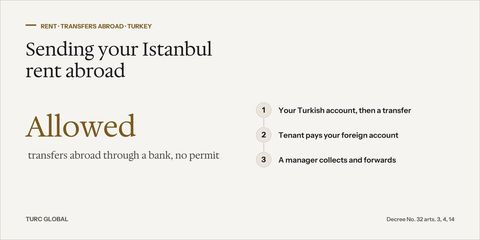
Is it allowed? Yes, through a bank
The rules on moving money in and out of Turkey sit in Decree No. 32 on the Protection of the Value of Turkish Currency, a 1989 decree the Treasury still amends and publishes in consolidated form. Three of its provisions answer the owner's question:
- Transfers of foreign currency abroad through banks are free, for people resident in Turkey and for people resident abroad alike (article 4(e)).
- People resident abroad may pay, collect and deposit Turkish lira in Turkey freely (article 3(b)). Holding a lira account fed by rent is ordinary.
- Transfers of personal capital in and out of Turkey through banks are free (article 14).
There is no permit to apply for and no annual limit. What the decree does ask of banks is a report: transfers abroad above the equivalent of USD 50,000 are reported to the authorities within 30 days. That is information, not approval, and a single month's rent on an Istanbul flat is nowhere near it. Twelve months sent in one go may be.
The one word that keeps recurring is bank. Rent that moves through banks is easy to send, easy to explain and easy to declare. Rent that moves as cash is a problem at every step, which is the last section below.
Three routes the rent can take
1. Tenant pays your Turkish account, you send it on
The most common set-up. The tenant pays by transfer to your lira account in Turkey on the due date, and you move the money abroad when you choose, from your banking app.
What it needs: a Turkish bank account in your name. Opening one as a foreigner needs a Turkish tax number and, at most banks, a visit to a branch or a power of attorney for someone who goes on your behalf. Once it exists, everything else can be done from abroad.
What it gives you: a clean Turkish bank record of every payment, which is exactly what the tax office expects to see; control over when you convert lira and when you send; and the option of paying Turkish bills (property tax, DASK, aidat) from the same account.
2. Tenant pays your foreign account directly
Possible, and some owners start this way. The tenant sends an international transfer to your account in your home country each month.
It works on paper. In practice it tends to fade: the tenant pays transfer fees each month and starts asking who covers them, some Turkish banks ask the sender what the payment is for, and a tenant who pays late once by SWIFT is harder to chase than one who pays a local account. It also leaves you without any money in Turkey for the bills that arrive there.
If you use it, write the account details and who pays the transfer costs into the lease, and keep every monthly statement showing the tenant as the payer. We have found no official guidance on whether a foreign bank's statement satisfies the Turkish rule that rent be documented through a bank, so ask your accountant before relying on it as your only record.
3. A manager collects it and forwards it
The tenant pays the management company's account in Turkey, the company forwards the net rent to you, abroad if you like, with a statement showing what came in and what went out. You do not need a Turkish account at all, and the tenant pays a local account, which is what tenants find easiest.
This is how our Full Management works; under Rent Monitoring the rent goes straight to your own account and we check that it arrived. The two are compared side by side on the property management page. Whoever you use, ask three questions before signing: whose account the tenant pays, within how many days the rent is forwarded, and what the monthly statement shows.
Which currency: write the lease in lira
Many owners abroad would like the rent in euros or dollars, so that the lira's moves are the tenant's problem. The law limits this.
Article 4(g) of the same decree says that people resident in Turkey may not agree real-estate leases between themselves in a foreign currency or indexed to one, except where the Ministry allows it. Two details matter for owners abroad:
- The test is residence, not citizenship. The decree counts as residents of Turkey everyone with a legal residence here, including Turkish citizens working abroad as employees, self-employed people or business owners (article 2(b)). Everyone else is non-resident.
- There are exceptions. The Treasury's published answers on the rule say that people resident abroad are outside the restriction, and that a lease where the tenant is not a Turkish citizen may be agreed in foreign currency. The same answers stress that this permits a foreign-currency rent; it never requires one.
So a foreign owner living abroad may, on the Treasury's reading, be able to agree a rent in euros. We still write leases in lira, for four reasons. The tenant almost always earns lira, and a rent that jumps when the lira falls is the rent that stops being paid. A foreign-currency rent cannot be increased at all for five years, as explained in the legal rent increase cap. The rent is declared and taxed in lira anyway. And the communiqué behind the exceptions is amended from time to time; if you want a foreign-currency lease, have a Turkish lawyer check the current text against your own residence and your tenant's.
What a lira lease does not stop you doing is converting promptly: you can move the lira into foreign currency on the day it arrives and send it on.
Exchange rates and fees: where the money leaks
Most of what an owner loses in sending rent abroad is not tax. It is the spread on the exchange and the fees on the transfer. Some practical points, none of them a forecast of the lira:
- Compare the bank's rate with a reference. The Central Bank of Turkey publishes indicative rates every working day. The gap between that and the rate your bank gives you is the real cost of the exchange, and it varies between banks and channels.
- Know where the conversion happens. If you send lira and your foreign bank converts it, you get that bank's rate. If you convert in Turkey first, you get the Turkish bank's. Try both once with a small amount.
- Count every fee. An international transfer can carry a sending fee, an intermediary bank's charge and a receiving fee. On a monthly transfer these add up faster than people expect; many owners send quarterly instead.
- Keep some lira in Turkey. Property tax, DASK and aidat are billed in lira. Sending everything out and then sending some back pays the spread twice.
What banks will ask, and what to have ready
Banks in Turkey, like banks everywhere, have to know where the money they move comes from. For rent, the questions are predictable, and the answers are documents you already hold:
| What they ask | What answers it |
|---|---|
| Where does this money come from? | The lease, showing the flat, the rent and the tenant |
| Do you own the property? | The title deed (tapu) |
| Is this a regular income? | Statements showing the monthly payments from the tenant |
| Why is the amount larger this time? | A short note: several months sent together, or a deposit being returned |
The easiest single habit: ask the tenant to write the month and the flat in every payment description ("Rent November 2026, flat 12"). It turns your statement into a record the bank, your accountant and the tax office can each read without asking you.
If someone handles the account for you under a power of attorney, check that its wording covers banking. Powers drawn up for a sale often do not. What a power of attorney from abroad involves is set out in selling your Istanbul property from abroad.
Taxes: sending it out changes nothing
Two separate things are often confused:
- The transfer is not taxed. Moving your own money from your Turkish account to your foreign one is not a taxable event.
- The rent is taxed in Turkey either way. Rent from a Turkish flat is Turkish-source income, taxed through the annual return each March whether the money stays here, goes to your foreign account, or was paid there directly by the tenant. The exemption, the expense options and how non-residents file are in rental income tax in Turkey.
Your country of residence may tax the same rent. Where there is a double tax treaty, it usually decides which country gives credit for the other's tax. That is a question for an accountant where you live, with your Turkish return in hand.
Cash: the route not to take
The offer comes sooner or later: the tenant would rather hand the rent to your cousin, who will bring it on the next trip. Decline it.
Rent must be documented through a bank or the post office whatever the amount, and a cash payment can be fined separately for the landlord and the tenant, month by month, with the details in collecting rent in cash. Taking the cash out of the country adds its own rules: foreign currency above the equivalent of EUR 10,000 leaves Turkey only under the conditions the Ministry sets (Decree 32, article 4(f)). And money that arrives abroad without a bank trail is money your own bank will ask about.
If the tenant has no Turkish account yet, as happens with foreign tenants in their first weeks, accept an international transfer for the first payments and make opening an account a condition of the lease.
A checklist for owners abroad
- Decide the route: your Turkish account, a direct transfer, or a manager who forwards.
- Write the rent in lira, and the payment account and description format into the lease.
- Keep every payment on a bank record, never cash.
- Keep the lease, the deed and the statements together: they answer the bank's questions.
- Leave enough lira in Turkey for property tax, DASK and aidat.
- Declare the rent in Turkey each March, and ask your home accountant about the treaty.
What we do, and what we do not do
We do not give tax or legal advice, open bank accounts for owners or file returns; a Turkish accountant (mali müşavir) and, for contracts in foreign currency, a lawyer do. What we do for owners abroad is the part around the money: we keep the flat let and looked after, collect the rent and forward it to you under Full Management, tell you what the flat is worth, and sell it when you decide to. The rules on this page were checked on 9 November 2026.