Before a flat in Istanbul can be let, sold or even insured, two Turkish identifiers come up again and again: a tax number and a bank account. Owners abroad ask us the same thing about both: "can I sort this out from where I live, or do I have to fly in?"
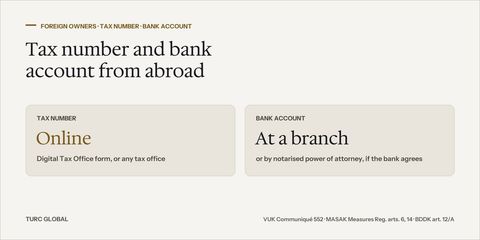
The answer is different for each. The tax number, in most cases, can be obtained online, and if you bought the flat you probably have one already. The bank account is where the trip, or a power of attorney, usually comes in. This page explains what each one is for, what the rules say, and the order that saves the most time.
What you need each one for
| You want to | Tax number | Turkish bank account |
|---|---|---|
| Sell the flat at the land registry | Needed | Not required by law, but the sale price must move through a bank |
| Declare rent each March | Needed (the return is filed under it) | Not needed |
| Receive rent from a tenant | Needed for the lease and utilities | Easiest route; a manager can collect for you instead |
| Pay property tax, DASK, aidat | Used to look up and pay | Makes it simple; foreign cards often fail |
| Open utility subscriptions | Needed | Needed for direct debit |
A tax number is an identifier, nothing more. Holding one does not mean you owe tax or have filed anything. The duty to declare comes from the rent, as explained in rental income tax in Turkey.
The tax number: usually done from abroad
First, check whether you already have one
If you bought the flat, you were given an identifier before the deed was signed: either a tax number (vergi kimlik numarası) or, if you held a Turkish residence permit at the time, the foreign ID number that starts with 99, which works as your tax number. It is usually printed on your purchase paperwork and on tax receipts from the sale.
Do not apply for a second number because the first one is lost. The Revenue Administration's Digital Tax Office offers both a query and a verification service for foreigners' tax numbers; they are listed among its official services in VUK General Communiqué No. 552 (Official Gazette, 7 October 2023). A query that finds your existing number saves a mismatch later between the deed, the tax office and the bank.
If you have none: the online form
The Digital Tax Office has a form called Potential Tax Number Application for Foreigners (Yabancılar İçin Potansiyel Vergi Kimlik Numarası Başvurusu). It asks for:
- your name, surname and gender
- your passport number, and your foreign ID number if you have one
- your place of birth and your mother's and father's names
- your country, a mobile number and an address
Type everything exactly as it appears in your passport, in Latin letters. Small differences in spelling between the tax record and the passport are what later stop a bank or the land registry. The form does not say how the number is delivered, so keep a screenshot of the result and confirm the number afterwards with the verification service.
Or at any tax office
Any tax office in Turkey issues a number against your passport. This is the fallback if the online form does not go through, and the simplest option if you are in Istanbul anyway, for example on the trip you make to open a bank account. Whether a tax office will issue the number to someone acting for you varies; a Turkish accountant (mali müşavir) can check with the office before you rely on it.
We have found no official source confirming that Turkish consulates issue tax numbers to foreign nationals, so we do not suggest relying on that route.
The bank account: where the trip comes in
Why it cannot usually be done online
Turkish banks can open accounts by video call without the customer being present. The regulation that allows it, issued by the banking regulator BDDK in 2021, defines the identity document for this purpose as the Turkish ID card. A 2023 addition extended video onboarding to holders of a Turkish ID booklet or a Blue Card (the card former Turkish citizens receive), and only for YUVAM accounts, a savings scheme for citizens living abroad.
A foreign passport on its own is not covered by the rules we read. So, for a foreign national, opening an account from home by app is generally not possible today. If you were once a Turkish citizen and hold a Blue Card, ask your bank about YUVAM; it is a savings product with its own conditions, not an everyday current account.
What the bank will check
The identification rules every bank follows are in the anti-money-laundering Measures Regulation (MASAK). For a foreign customer, article 6 says:
- Identity is confirmed from a passport, a residence document or another document the Ministry accepts. The bank sees the original or a notarised copy and keeps a copy.
- The bank records your name, date and place of birth, nationality, the document's number, your address, your signature and what you do for a living.
- For an ongoing relationship such as an account, your address is verified: a utility bill in your name from the last three months, a document from a public body, or another method the authority accepts.
In practice banks also ask for your Turkish tax number, which is another reason to sort that out first. And they ask what the account is for. "Rent from my flat in Istanbul" is a complete answer when the lease and the title deed are in your folder.
Through a power of attorney
If you cannot come, the same regulation allows someone to act for you. Article 14 says that where a transaction is made by another person on an individual customer's behalf, the bank identifies that person, checks their authority through a notarised power of attorney, and, if it cannot identify you directly, identifies you through that power of attorney.
So the law permits it. Whether a particular bank accepts it is the bank's own decision, and many prefer to meet the account holder once. Three practical steps:
- Ask the branch first whether it opens accounts for non-resident foreigners through a representative, and what wording it wants in the power of attorney.
- Draw up the power of attorney with banking powers spelled out: opening an account, running it, ordering cards. Powers drawn up for a sale often do not cover banking. How a power of attorney from abroad is made is explained in selling your Istanbul property from abroad.
- Plan for the card and the app. Debit cards and internet-banking passwords are often handed over or activated by the account holder in person. Ask how the bank delivers them to a customer abroad.
The order that saves a trip
- Find or get the tax number from abroad, through the Digital Tax Office query or the online form.
- Collect your documents: passport, the title deed, an address document in your name, and the lease if the flat is let.
- Ask one or two banks what they need from a non-resident foreigner, and whether they accept a representative.
- Open the account on your next visit, or through a power of attorney if the bank agrees. Set up internet banking before you leave the branch.
- Give the account details to the tenant and the lease, with a payment description such as "Rent December 2026, flat 12".
If you do not want a Turkish account at all
Nothing in the law requires an owner to hold one. Rent must be documented through a bank, but that can be the tenant paying a manager's account, which then forwards the rent to you abroad. This is how our Full Management works; under Rent Monitoring the rent goes to your own account and we check it arrived. The routes, currency rules and transfer costs are compared in sending rent abroad from Turkey, and paying the property tax without a Turkish account is covered in how to pay property tax from abroad.
What we do, and what we do not do
We do not open bank accounts or obtain tax numbers for owners, and we do not file tax returns; the bank, the tax office and a Turkish accountant do that, and a notary prepares the power of attorney. What we do for owners abroad is everything around the flat: we keep it let and looked after, collect the rent and forward it to you under Full Management, tell you what it is worth, and sell it when you decide to. The rules on this page were checked on 21 November 2026.