Most foreign owners of Istanbul property have thought about buying, letting and selling. Fewer have thought about the day the flat passes to their children, and the families who meet that day unprepared usually meet it from abroad, with a death certificate in one language and a Turkish title deed in another.
Three facts decide almost everything that follows. Turkish law, not the law of your own country, decides who inherits a flat in Turkey. The heirs need a Turkish certificate of inheritance, which a foreign grant of probate does not replace. And the deed can be put in the heirs' names before the inheritance tax is paid, but the flat cannot be sold until it is. This guide takes them in the order a family abroad will meet them.
Turkish law decides who inherits the flat
Article 20 of Turkey's private international law (Law 5718) says succession follows the deceased's national law, and then makes one exception: Turkish law applies to immovable property in Turkey. A British, German or Singaporean estate may be governed by its own law everywhere else; the Istanbul flat is not.
In practice that brings in the Turkish shares from the Civil Code (Law 4721, article 499). With children, the surviving spouse takes a quarter and the children share the rest equally. With no children but parents (or their line), the spouse takes half; further out, three quarters; with no relatives in those groups, everything.
It also brings in reserved shares (saklı pay, article 506): half of the statutory share for each child, the full statutory share for a spouse who inherits alongside children or parents. A will that leaves the Istanbul flat to one person can be cut back by the others through a reduction action if it breaches those shares. Wills themselves are not the problem: a will made in the form the law of the place requires, or in the form of the deceased's own national law, is valid in Turkey (article 20(4)). Before it can be relied on, though, it is opened by a Turkish civil court of peace.
Step 1: a Turkish certificate of inheritance
The land registry, the tax office and the banks all work from one document: the mirasçılık belgesi, still widely called veraset ilamı. It lists the heirs and their shares. The Civil Code (article 598) lets either a civil court of peace (sulh hukuk mahkemesi) or a notary issue it.
The notary route is quick but works from Turkey's population register. Where the deceased was a foreign national, or the family's records are foreign, the certificate is in practice obtained from a civil court of peace, usually in the district where the property is. A foreign grant of probate or certificate of succession does not take its place at the registry; it becomes supporting evidence for the Turkish application.
What the court will want, in some form:
- The death certificate, apostilled (or legalised, if the country is outside the Apostille Convention) and translated by a sworn translator in Turkey.
- Proof of the family relationships: birth and marriage certificates, the same way.
- Passports or identity documents of the heirs.
- The will, if there is one.
None of it requires a flight. A Turkish lawyer acting under a power of attorney given at a Turkish consulate, or before your own notary and then apostilled, can apply for you. How that power is drafted is set out in selling property in Turkey from abroad.
If the estate may owe more than it holds (a mortgage on the flat, debts elsewhere), note the clock: an heir can disclaim the inheritance within three months of learning of the death (Civil Code article 606). After that, the debts come with the flat.
Step 2: the inheritance tax return, on a clock that starts at the death
Property located in Turkey is taxed when it passes by inheritance, whatever the nationality of the deceased or the heirs (Inheritance and Transfer Tax Law, Law 7338, article 1). Each heir files for their own share; one joint return signed by all is also accepted. The deadline (article 9) depends on where the death happened and where the heirs are:
| Where the death happened | Where the heirs are | Deadline from the day after the death |
|---|---|---|
| Turkey | Turkey | 4 months |
| Turkey | Abroad | 6 months |
| Abroad | Turkey | 6 months |
| Abroad | Same country as the deceased | 4 months |
| Abroad | Another foreign country | 8 months |
The return goes to the tax office of the deceased's last residence in Turkey. If the deceased never lived in Turkey, the Revenue Administration's guidance points to the tax office where the property is, and the return should then cover everything the deceased left in Turkey (GİB guide for heirs). The certificate of inheritance is attached, with a copy of the title deed and the municipality's statement of the flat's property-tax value.
The flat is taxed at its property-tax value (emlak vergisi değeri) for the year of death, not at market price. After the 2026 reassessment that value has risen, but it is often still below what the flat would sell for. The 2026 figures, from the Revenue Administration's General Communiqué No. 57 (summary by KPMG):
- Exemption of ₺2,907,136 for each child and for the spouse; ₺5,817,845 for a spouse when there are no children. Other heirs (parents, siblings) have no exemption.
- Rates on what is left of each heir's share: 1% on the first ₺3,000,000, 3% on the next ₺7,000,000, 5% on the next ₺15,000,000, 7% on the next ₺30,000,000 and 10% above ₺55,000,000.
Two worked examples, both for a flat with a property-tax value of ₺8,000,000 (simplified: no debts, no other assets in Turkey, and the surviving spouse's marital-property claim left aside):
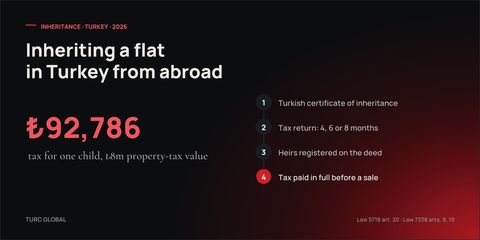
- One child, no spouse. ₺8,000,000 − ₺2,907,136 = ₺5,092,864 taxable. 1% of ₺3,000,000 is ₺30,000; 3% of the remaining ₺2,092,864 is ₺62,786. Total ₺92,786.
- A spouse and two children. The spouse's quarter is ₺2,000,000, under the exemption: no tax. Each child's three-eighths is ₺3,000,000; ₺92,864 above the exemption at 1% is ₺929 each.
The tax is assessed after the return and paid in six equal instalments over three years, in May and November (article 19). It can be paid from abroad by bank transfer to the tax office's account. A late return brings a penalty; with deadlines of up to eight months, the certificate of inheritance is the step to start first.
Step 3: the heirs on the title deed, and the sale block
With the certificate in hand, the heirs apply to the land registry to be recorded as owners (intikal). This is not a sale: the 4% title-deed fee does not apply, and the registry charges its own service fee. The step is usually booked through the Web Tapu system and done in one appointment, in person or through a representative with a power of attorney.
The registry does not wait for the tax. Article 19 says inherited property is registered without waiting for the tax assessment, and the registry tells the tax office within 15 days. The same article then sets the rule that catches families out: the property cannot be sold, and no right such as a mortgage can be created on it, until the inheritance tax falling on it has been paid in full. The registry needs the tax office's clearance letter (ilişik kesme belgesi) before a sale. A family that wants to sell before the three years of instalments are over must therefore pay the rest early, unless the tax office accepts security in its place.
Two more checks happen at the registry for a foreign heir:
- Nationality and area limits. Most nationalities may own property in Turkey. If an heir's country is not on the list, or the inheritance takes them over the area limits (30 hectares per person nationally, 10% of a district), Tapu Kanunu article 35 (Law 2644) does not stop the inheritance: it requires the heir to sell within a period the Ministry sets, of no more than a year, or the Treasury sells and pays them the proceeds.
- Military and security zones. As with a purchase, the registry asks whether the property is in such a zone before registering a foreign national. For a flat in central Istanbul this is a formality.
Unpaid property tax on the flat does not stop the registration to the heirs, but it does stop a later sale. So does an old identity mismatch on the deed: if the deceased bought with a passport and later became a Turkish citizen, the record may need correcting first (see title deed not showing in e-Devlet after citizenship).
Several heirs, one flat
Until the estate is divided, the heirs own the flat jointly (elbirliği mülkiyeti, Civil Code article 640) and act on it together: one heir cannot sell "their part" of a jointly owned flat. If the family cannot agree who speaks for it, any heir can ask the civil court of peace to appoint a representative until division.
Any heir can also ask for the estate to be divided at any time (article 642). The court allots the property in kind where it can; a single flat that no heir takes is sold, in practice at public auction, after valuation, fees and months of hearings. Families who agree early (one heir buys the others out, or all sell together, or all keep it and let it with one person authorised to deal with the agent) almost always end up with more.
Running the flat in the meantime
- The tenant stays. The lease continues with the heirs as landlord. Once the heirs agree which account the rent goes to, tell the tenant in writing; until then the rent is owed to all of them jointly.
- The bank account. A Turkish bank pays out a deceased customer's balance only against the tax office's letter, or withholds 5% as security for the inheritance tax (article 17 of the tax law, as explained in the GİB guide).
- The deceased's own tax return. If the deceased had rental income to declare for the year of death, the heirs file that return within four months of the death (GİB guide). From then on, each heir declares their own share of the rent under the usual rental income tax rules.
- DASK. The compulsory earthquake policy continues for the new owners; the insurer must be told within 15 days of learning of the change (DASK from abroad).
- Property tax. The November instalment still falls due; arrears block a later sale. Paying from abroad is covered in how to pay property tax in Turkey from abroad.
If you are the owner: three things to do now
- Make the deed match your identity today, so your heirs are not untangling an old passport number after you have gone.
- Leave your family a one-page file: the deed details (province, district, ada, parsel, unit), the municipality and its tax number for the flat, the DASK policy number, the bank holding the rent, the tenant's lease, and who manages the flat.
- Take advice on a will for the Turkish property, made with the reserved shares in mind. A will that ignores them invites exactly the court case it was meant to avoid.
We do not obtain certificates of inheritance or file tax returns; a Turkish lawyer and an accountant do. What we do for families abroad is the part around them: we keep the flat let and looked after while the paperwork runs, tell you what it is worth when the heirs have to decide between keeping and selling, and sell it once the deed and the tax office allow. Every rule here is the one in force on 19 October 2026. Exemption amounts and brackets change every January, so check the year of the death before you rely on a figure.