Your flat in Istanbul is with a management company that pays late, answers late, or has stopped answering. You live abroad, so changing companies feels like a trip you cannot make. It is not one. Turkish law lets you end a management arrangement and take everything back in writing, and no step of a switch needs you in the city.
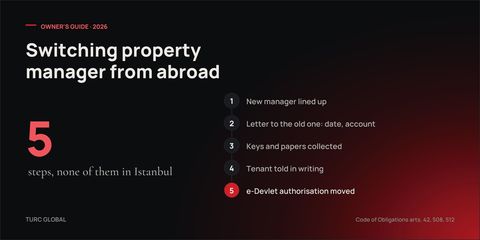
What decides whether a switch goes well is the order. Done in the wrong order, the tenant does not know whom to pay, a month of rent goes missing between two companies, and the deposit turns into an argument. Below are the steps in the order we would take them, with the rule behind each.
Before you start: what your contract says
Find the contract you signed with the company and read three things.
- The term. The Regulation on Real Estate Trading requires the written authorisation contract to state how long it runs (article 15).
- Any withdrawal fee. The same article allows a fee for withdrawing from the contract, and caps it: for the business it may not exceed the total service fee.
- The notice period, if the contract sets one.
The Code of Obligations adds a general rule. In legal terms a management arrangement is usually a mandate, and brokerage contracts follow the mandate rules too (article 520). Either side may end a mandate at any time, but the side that ends it at an inopportune moment must make good the loss this causes the other (article 512). In practice that means: you can leave, and the cleanest way is on a date the contract allows. Where the sums involved are large, ask a lawyer before you choose the date.
Do not expect a refund of a letting fee paid when the current tenant was found, unless it was above the legal cap of one month's rent plus VAT. The regulation says an agency earns its fee by delivering the service in its contract (article 20), and finding that tenant was the service.
If you gave the company a power of attorney (vekâletname), plan to revoke it. A Turkish notary issues a revocation (azilname), and Turkish consulates do the same for citizens abroad, by appointment, with the power of attorney's date and number and the attorney's ID number and address. If you are not a Turkish citizen, ask the consulate first: for anything other than title-deed powers, consulates usually refer non-citizens to a notary where they live. Until the revocation has reached the attorney, assume the power of attorney still works.
Step 1: Line up the new manager first
Choose who takes over before you tell the old company anything, and have the new contract in writing first. A let flat needs someone answering the tenant's phone every day of the switch; a gap is when rent goes unpaid and a leak goes unreported. Agree the handover date with the new manager, then set the old company's end date to match.
Our guide to choosing a property management company in Istanbul lists the checks to run on the new one: the licence on the Ministry register, a written contract, fees with VAT, and where your rent goes.
Step 2: Write to the current company
One letter does the work. It should say:
- The date the management ends, in line with the contract, and that the authority you gave the company ends with it.
- Stop acting for you after that date: no rent collected, no dealings with the tenant in your name.
- Take down any listing within three days. The regulation requires an agency to end its advertising within three days once its authorisation contract is terminated or expires (article 14).
- Hand over the keys and documents to the person you name.
- Give a final account. Article 508 of the Code of Obligations obliges an agent, when asked, to account for its work and hand over what it received in connection with the mandate, including rent it has not yet paid you, and to pay interest on money it hands over late. Ask for the account in writing.
Our free key release letter tool prepares all of this in Turkish, with the English under each part, and adds the handover record both sides sign. Send it by e-mail or WhatsApp and keep the reply. Send it in a way you can prove: under article 514, what an agent does before it learns the mandate has ended still binds you as if the mandate continued.
Step 3: Collect the keys and the paperwork
These are the things to get back, and why each one matters.
| What to collect | Why it matters |
|---|---|
| Keys, door and garage remotes, access cards | Access for inspections and for the next letting |
| The original lease, or its e-Devlet contract number | The rent, the increase date and the end date all come from it |
| Any eviction undertaking (tahliye taahhütnamesi), original | Your evidence if the tenant does not leave when promised |
| Your copies of the contracts you signed with the company | The term and any withdrawal fee are in them |
| Notices sent to the tenant, any court or enforcement file, any arrears | Some deadlines are a month long: an eviction undertaking, and two justified notices for unpaid rent, must be acted on within a month (article 352) |
| Where the deposit is held: bank and account | You answer for it at move-out |
| The inventory and move-in record, with photos | The baseline for any deduction from the deposit |
| A statement of rent collected and payments made, with receipts | Your final account, and your next tax return |
| Utility, service-charge (aidat) and DASK details | So nothing lapses or is cut off in the switch |
| The tenant's contact details | So the new manager can introduce itself |
| The original power of attorney, if you gave one | The agent must return it when its authority ends (article 44); returning it does not revoke it |
The company must give you copies of everything it had you sign (article 14 of the regulation) and must keep its file on your property for at least five years, so "we no longer have it" is rarely the full answer.
For a flat that is let, the keys in daily use are with the tenant; the company holds a spare set. The documents and the money matter more than the spares. For an empty flat, the keys are everything, and if a set never comes back, a new lock cylinder is often quicker than chasing it.
Step 4: Tell your tenant, in writing
Your tenant pays whoever they were told to pay. Article 42 of the Code of Obligations says that if you made an agent's authority known to a third party, you cannot rely on having withdrawn it against a third party acting in good faith until you have told them. Your tenant is that third party.
So write to the tenant yourself, in Turkish, and say who the new contact is from which date, how to reach them, and where the rent goes from now on. Keep the new contact's role to rent, repairs and day-to-day matters, and say that any change to the lease still needs your written consent: under article 41, authority you announce to a third party is as wide as the announcement says. Rent must still be paid through a bank or the PTT, whatever the amount, under General Communiqué No. 328; the cash-rent rule explains the penalty. Ask the tenant to confirm by reply. The key release letter tool writes this second letter for you when you say the flat is let.
Nothing else changes for the tenant, as long as the lease names you as the landlord: it is between you and them, and it stays as it is. If the company signed the lease as landlord in its own name rather than for you, ask a lawyer before you switch, because the lease may then bind the company rather than you (article 40).
Step 5: Check where the deposit is
Under article 342 of the Code of Obligations a cash deposit may not exceed three months' rent, and the tenant should pay it into a time-deposit account that cannot be withdrawn without the landlord's consent. In practice many deposits are handed over in cash and held by the landlord or the agent. Ask the old company, in writing, where yours is. If it says it holds the deposit itself, ask for the amount in writing and for it to be placed in such an account, or handed over to you against a receipt. At move-out, the tenant will look to you, the landlord, for the deposit, whichever company held it. Our end-of-tenancy guide covers what happens then.
Step 6: e-Devlet and the listings
- Listing authorisation. Since 1 January 2025 an agency cannot advertise your property online unless you have authorised it through e-Devlet (EİDS). Withdraw the old agency's authorisation on the same screen and, if the flat is to be let again, authorise the new one. Our page on the e-Devlet listing authorisation shows where, and our EİDS guide covers owners without e-Devlet access.
- Listings. Three days after the end date, search the portals for your flat. A listing still up is a breach of the regulation, which the Ministry of Trade enforces with administrative fines (article 22).
- The e-Devlet lease, if your lease was made there, stays as it is: it is between you and the tenant.
Step 7: The final account and the money
Ask for the final statement to cover everything up to the end date: rent collected, each deduction with its invoice, and the date and amount of the last transfer to you. If the company prepared your rental income return in past years, ask for this year's figures as well; the March return needs them. Our rental income tax guide explains what goes on it.
Finally, tell the building's management (site yönetimi) in writing who acts for you now, so notices and repair requests reach the right person.
If the old company will not cooperate
Ask once more in writing, with a date. If it says something is owed first, ask for the contract clause and an invoice in writing; pay what the contract really owes, and put any dispute in writing. If nothing moves, a notary notice (ihtarname) is the formal next step, and a lawyer in Istanbul can send one for you and advise on what follows.
A switch, in order
- Read the contract: term, notice, any withdrawal fee.
- Choose the new manager and sign its contract.
- Send the letter to the old company with the end date, the handover list and the request for a final account.
- Collect the keys and papers against your signed authorisation, with a handover record.
- Write to the tenant: the new contact, the date, the account for the rent.
- Move the e-Devlet listing authorisation; check the portals after three days.
- Get the final account, and tell the building's management.
How we take over
If you choose us, you first sign our written management contract, as the regulation requires (article 15). Then you sign the key release letter and send us a scan; we collect the keys and documents against it, count and photograph the keys, and send you the handover record the same day. From then on the flat runs on the tier you choose: Rent Monitoring at 5% or Full Management at 10% of the rent actually collected, plus VAT, with nothing charged while the flat is empty. Under Full Management the collected rent is forwarded to you within 3 working days, to a Turkish or a foreign account, and the flat is inspected with a photo report every 6 months and at every change of tenant. The details are on the property management page.