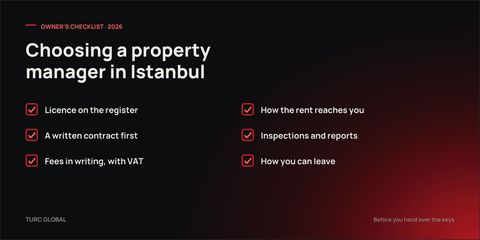
You live abroad and own a flat in Istanbul, and you have asked a friend, a forum or an AI assistant to recommend a property management company. Whatever names you were given, the useful question is the next one: how do you tell whether a company will look after the flat and your money properly, from another country?
Turkish law answers some of that for you, and leaves the rest to the contract you sign. Below are the eight checks we would run ourselves, each with the rule behind it, followed by the questions to send any company before you hand over the keys. We are a property management company, so at the end we say how we answer each check; you can hold us to the same standard.
1. The licence: check it on the Ministry register
Finding tenants for property is regulated. Under the Regulation on Real Estate Trading, real-estate trading may only be carried out by businesses holding an authorisation certificate, the taşınmaz ticareti yetki belgesi (article 5), and the definition expressly includes brokering lettings (article 4). The certificate is issued to one business and cannot be transferred.
Ongoing management has no licence of its own. The regulation lists following rent payments and utility subscriptions, arranging repairs and maintenance, keeping the owner informed and "consultancy and management" as services a licensed business may provide alongside letting (article 13). In practice, then, management sits with a licensed business that also handles the letting.
How to check, in a minute:
- Ask for the licence number. It must appear in every advert the company places, with the business name on the certificate (article 14).
- Enter it on the Ministry of Trade's public register, ttbs.gtb.gov.tr. You can also search by business name or province.
- Compare the name on the register with the company on the contract and the invoice. A mismatch, or a number that does not exist, ends the conversation.
2. A written contract, before any work starts
The regulation says services are given on the basis of a written authorisation contract between the owner and the business, in at least two copies, one for each side (article 15). It must state, at minimum, the services and their fees, both sides' rights and duties, the term, the notice addresses and any withdrawal fee, which may not exceed the total service fee. Separately, the Code of Obligations says a real-estate brokerage contract is not valid unless it is made in writing (article 520).
When a tenant is found, a second, three-party letting brokerage contract records the rent, the yearly increase and how the rent is paid (article 17). The business must explain what you are signing and give you a copy of everything.
What to look for in the management contract itself: exactly which services are included and which are extra, who approves repairs and up to what amount, how often you get a statement, and anything the company is to do at the land registry, tax office or municipality for you, which the regulation allows only if the contract says so expressly (article 13).
3. Fees: in writing, with VAT, and nothing hidden
For finding a tenant the legal ceiling is one month's rent, excluding VAT, and unless the contract says otherwise it is split equally between owner and tenant (article 20). Our commission guide covers who pays in practice.
The regulation sets no separate rate for ongoing management. It is usually a percentage of the rent, and the details matter more than the headline figure:
- Is the percentage charged on rent actually collected, or on the rent due?
- Is anything charged while the flat stands empty, or to set the account up?
- Is VAT included in the quoted rate?
- Are repairs passed on at cost, with the contractor's invoice, or with a mark-up?
- What does an inspection, a renewal or a tenant change cost, if anything?
Ask for an invoice for every fee. It is your evidence if anything is disputed, and the basis for deducting the cost if you declare rental income tax on actual expenses.
4. Your money: where the rent goes, and how fast
This is the check owners abroad most often skip. Turkey has no client-money protection scheme for letting agents: no ring-fenced client account, no compulsory insurance and no deadline for passing rent on. Your protection is the written contract and the agent's general duty under the Code of Obligations to account for its work and hand over what it receives for you, with interest if it is late (article 508).
Two things shape the answer:
- Rent must go through a bank or the post office, whatever the amount. Since General Communiqué No. 328 (17 October 2024) every residential and commercial rent payment must be documented by a bank or PTT, with a separate penalty for the landlord and for the tenant of 10% of each payment, and at least ₺5,000 per payment (the 2024 figure, raised every year), when it is not. A company that offers to collect rent in cash is putting you at risk; see the cash-rent rule.
- There are two honest models. Either the tenant pays your own account and the company monitors the payment, or the tenant pays the company and it forwards the rent to you. In the second model, ask how many days it takes to reach you, whether it can go to an account outside Turkey, who pays the transfer cost and what statement you receive each month.
5. The tenant and the deposit
Ask how tenants are checked: identity, income, references, and whether you approve the tenant before anything is signed. Our tenant screening guide lists what a good check covers.
The deposit has a legal shape of its own. For residential lets it may not exceed three months' rent, and a cash deposit is paid by the tenant into a time-deposit account that cannot be withdrawn without the landlord's consent (Code of Obligations, article 342). A company that wants to keep the deposit in its own account is not following that model; ask how it will be handled. What happens at move-out is in our end-of-tenancy guide.
6. Powers: what you sign over, and what you do not
To advertise your flat online a company no longer needs a power of attorney. Since 1 January 2025 an agency cannot publish a listing on an online property platform, rentals included, until the owner has authorised it through e-Devlet (the Electronic Listing Verification System, EİDS), and the Ministry is explicit that this gives the agency no power over the title deed and does not replace the written contract. Our EİDS guide covers the steps, including for owners without e-Devlet access.
If a company asks for a power of attorney, ask what for, and grant only those powers. Under the Code of Obligations an agent cannot bring a lawsuit, settle, or transfer or burden your property unless specially authorised (article 504). Managing a let flat does not require a power to sell it.
7. Inspections, reports and emergencies
No law sets how often a manager visits or reports, so this is where companies differ most, and where you should ask for promises in writing:
- How often is the flat inspected, and do you get dated photos?
- What do you receive each month: a statement of rent received, costs paid and the balance?
- Who handles a leak at night or at a weekend, and how quickly?
- Who keeps the yearly calendar for you: DASK earthquake insurance, property tax, the legal rent increase at renewal and the March rental income tax return?
8. How you can leave
Read the exit before you sign. The authorisation contract states its term and any withdrawal fee, and the regulation caps that fee at the total service fee. Ask what is handed back when the relationship ends: keys, the signed lease, the deposit account details, receipts, the tenant's contact details and the inspection photos. A company confident in its service has no reason to make leaving hard. If you are already with a company and want out, the steps, in order, are in switching property management company from abroad.
Red flags
- No licence number, or a number registered to a different business.
- "We don't need a contract", or a contract with blank fee lines.
- Rent collected in cash, or "into my personal account".
- A request for a general power of attorney, including the power to sell.
- The deposit kept in the company's account with no explanation.
- A rent figure promised before anyone has seen the flat.
- No written answer to "how fast will the rent reach me?"
The questions to send any company
Copy these into an email or a WhatsApp message. A good company answers all of them in writing.
- What is your real-estate trading licence number, and the business name it is registered to?
- Will you send the written contract before any work starts? What exactly is included, and what costs extra?
- What do you charge to find a tenant, and for management? On rent collected or rent due? With or without VAT? Anything while the flat is empty?
- Does the tenant pay me directly or pay you? If you, how many days until the rent reaches my account, and can it go abroad?
- What statement will I receive each month?
- How do you check tenants, and do I approve the tenant before signing?
- How will the deposit be held?
- Which powers do you need from me, and why?
- How often do you inspect, and do I get dated photos?
- Who handles emergencies at night and at weekends?
- Who keeps track of DASK, property tax, the rent increase and the tax return?
- How do I end the contract, and what do you hand back?
How we answer these
We are a licensed Istanbul agency, so here are our answers, in the same order:
| Check | Turc Global |
|---|---|
| Licence | Real Estate Trading Licence No 3417413, on the Ministry register |
| Contract | A written contract before any work starts |
| Management fee | 5% or 10% of rent actually collected, plus VAT; nothing while the flat is empty (fees page) |
| Your rent | Under Full Management, collected rent forwarded within 3 working days, to a Turkish or foreign account |
| The tenant | You approve the tenant before anything is signed |
| Inspections | A visit with a photo report every 6 months and at every change of tenant |
| Emergencies | An emergency line in the evenings and at weekends |
| Tax | Under Full Management we prepare the rental income tax file and our partner accountant files it in your name |
The term and any withdrawal fee are in the written contract, as the regulation requires; ask us about anything else on the list before you sign. A good place to start is a free valuation. If you would rather start with the service itself, see property management for owners abroad.