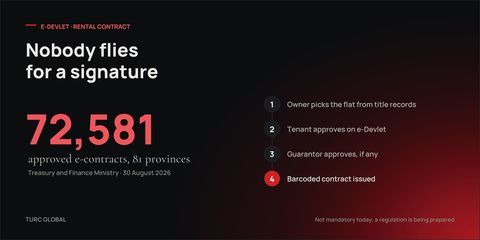
On 30 August 2026 the Turkish Treasury and Finance Ministry published a number: 72,581 rental contracts had been approved through e-Devlet, the state's online portal, from all 81 provinces. The same statement carried one more sentence, and that sentence made the news: the Ministry is working on a regulation to make all rental contracts mandatory through e-Devlet.
The following week two headlines ran side by side: "Rental contracts to become mandatory on e-Devlet" and "Lawyer warns: not yet." Both are true. This article covers what is actually the case today, how the contract is made on screen, and what it means for a landlord. It pays particular attention to owners who live outside Turkey, for whom this quietly solves the oldest problem in remote letting: how to sign.
Is it mandatory today? No. Tomorrow? Probably.
Under the Turkish Code of Obligations a lease is not a form-bound contract; it can be made on paper, even orally. As of today, a lease made outside e-Devlet is fully valid and there is no administrative fine for using paper. A mandate would need a law passed by Parliament and published in the Official Gazette, and as of 9 September 2026 there is no bill text, date or penalty. Talk of "the October omnibus law" is speculation.
The direction is clear, though. The Ministry stated its reason plainly (preventing fraud and citizen grievances), the service has been expanded in stages for two years, and the figures are published monthly. Our advice is not to wait for the mandate but to switch at your next letting or renewal, for the reasons below. What a Turkish lease should contain is in what a Turkish rental agreement must include; this page is only about how the signature happens.
What the service is, and how it grew in two stages
The service is called "Kira Sözleşmesi İşlemleri" and sits under the Treasury and Finance Ministry on e-Devlet. Login is by e-Devlet password, mobile signature, e-signature, the Turkish ID card or internet banking.
- Stage one, 4 November 2024. The owner, as a natural person, selects the property from the land-registry records, enters the tenant's details, the rent and the terms. The tenant and, if there is one, the guarantor approve from their own e-Devlet accounts. The output is a time-stamped, barcoded contract that anyone can verify on e-Devlet.
- Stage two, 9 May 2025. Authorised estate agents can now prepare the contract and route it for approval by the owner, any co-owners, the tenant and the guarantor. Two functions were added: correction of material errors within 15 days of approval, and later updating of contact details, the rent amount and payment terms.
Stage two is what matters to you: we prepare the contract, you only approve it.
Step by step: the owner's side
- Check the title record. The system pulls the flat from the land registry, and every co-owner on the deed must approve. On a flat owned by two siblings, one approval is not enough. On a shared title, make sure everyone has e-Devlet access first.
- Get the tenant's identity number. A Turkish ID number or a foreign ID number (yabancı kimlik no) is required; the tenant approves with it from their own account. A foreign tenant without a foreign ID number cannot use the service, and the lease stays on paper; see letting to foreign tenants.
- Enter the real rent. The most important line on this page; it has its own section below.
- Enter the deposit, start date, payment day and term. Writing the deposit into the contract protects you; who pays what, deposit included, is tabulated in aidat, repairs, deposit: who pays for what.
- Add a guarantor if there is one. They approve from their own account; the handwriting formalities the law requires for a guarantee are handled inside the system.
- Send for approval and download the barcoded contract. The lease exists the moment the tenant approves. File the PDF.
The tenant's and guarantor's side
The tenant logs into their own e-Devlet, finds the pending contract under the same service, reads the terms and approves or rejects. The guarantor does the same. Approval stands in for a signature; nobody has to sit at the same table.
Once the contract exists, electricity, water and gas providers accept the barcoded document for subscriptions. The tenant can move in without chasing a notarised copy or a wet-ink original.
What changes for an owner abroad
This is the least discussed and, in our view, the most valuable side of the service. Until now an owner letting from abroad had three bad options: a power of attorney at a consulate, a wet-ink lease travelling by courier in both directions, or a pre-signed undated contract. The e-Devlet lease removes all three:
- e-Devlet passwords are issued abroad at Turkish embassies and consulates, by appointment. They go to Turkish citizens, holders of the Blue Card (Mavi Kart: former citizens who gave up citizenship but kept most rights) and foreigners who hold a foreign ID number. With a password you approve the lease from Vienna, Singapore or Dubai.
- We prepare, you approve. The agent authorisation added in stage two exists for exactly this.
- The tenant's side closes remotely too. The tenant is in Istanbul, you are on another continent, nobody flies for a signature.
The only physical step left for a remote owner is the key handover and the move-in inspection, which is what property management for remote owners covers. Foreign owners without a foreign ID number still cannot log into e-Devlet; for them the power-of-attorney route remains.
The real gain for a landlord: a signature that cannot be denied
The weakest point of a paper lease is the day of a dispute, when the tenant says "that is not my signature" or "that is not what we agreed". Expert reports, forensic examination, months. An e-Devlet approval cannot be denied: it was given under the tenant's own identity, with a timestamp. An eviction claim or a rent-arrears case starts without arguing whether the lease exists. Anyone who has read evicting a tenant in Turkey knows what that removes: the most expensive argument, before it starts.
The second gain is order. No lost original, no missing copy, no unreadable date. The third is cost: the service is free, and residential leases between individuals have been exempt from stamp duty since 2017, which e-Devlet does not change. Commercial leases carry stamp duty on paper and on screen alike.
Two traps
First: the rent you enter becomes evidence. A landlord who understates the rent has produced, under their own electronic signature, a record of an understated declaration. It will not help in a rent-determination case, in the income-tax return, or at a sale one day. Rent has to be collected through a bank anyway; the cash-rent penalty explains why. Enter the real figure and declare it as set out in rental income tax in Turkey.
Second: an approved contract cannot be cancelled unilaterally. Correction is limited to material errors within 15 days of approval. A contract approved "just to have a look" is a contract. Read every line before approving, including the ones we prepare for you.
And one misunderstanding worth clearing: the e-Devlet contract does not prove payment. Only a bank record proves that rent was paid. Consumer associations made exactly this point when the news broke, and they were right.
The vacate undertaking and the handover record are still separate paper
The e-Devlet contract is the lease itself. A landlord's strongest document, the vacate undertaking (tahliye taahhütnamesi), is a separate document, must be dated after the lease, and does not live on the e-Devlet screen. The same goes for the move-in inspection and the inventory. Switching to e-Devlet does not reduce the paper in your file to zero; it reduces it to two documents.
There is a specific warning here for anyone renewing. If you hold a valid undertaking and then sign a new lease with the same tenant, a Supreme Court ruling published in summer 2026 says that undertaking can be void. That is why, on e-Devlet, you should use the "update" function at renewal rather than creating a new contract; the details are in renewing a lease can void your eviction pledge.
If you are signing soon: the short list
- Every co-owner on the deed has e-Devlet access.
- I have the tenant's Turkish or foreign ID number; if not, the lease stays on paper.
- The rent is the real rent; the deposit is written in.
- At renewal I use "update", not a new contract.
- The vacate undertaking is separate and later-dated; the handover record is separate.
- Rent goes through a bank, only.
If you would like us to run the whole flow, from tenant screening to contract approval, letting yourself vs using an agency sets out what you hand over. The starting point is always a free valuation.
Once this is sorted, check the rest: the ten things owners abroad most often miss are in one list. Take the remote owner check, see your score in a minute and send us your gaps in one message.