Owners abroad usually meet these two words late: when a buyer's bank asks for the occupancy permit, or when a new tenant cannot open an electricity account. The questions that follow are always the same. "Does this stop me letting or selling? What does it cost me? Can I fix it without flying in?"
The short version: neither kat irtifakı nor a missing occupancy permit stops a lease or a sale. Both are legal states that thousands of Istanbul flats are in. What they change is who will rent or buy, how fast, and at what price. This guide explains the terms, how to check where your flat stands, and what can be done from abroad.
Three terms on one page
Turkish property law uses three terms that owners often mix up.
| Term | What it is | Where it comes from |
|---|---|---|
| Kat irtifakı | A right over a future flat, attached to a share of the land, created before the building is finished | Kat Mülkiyeti Kanunu (Law 634), art. 2(c) |
| Kat mülkiyeti | Full ownership of the finished flat as a separate property, with its land share and the common parts | Law 634, arts. 2(a) and 3 |
| Iskan (yapı kullanma izin belgesi) | The occupancy permit: the municipality's confirmation that the building matches its construction permit and is fit to use | İmar Kanunu (Law 3194), art. 30 |
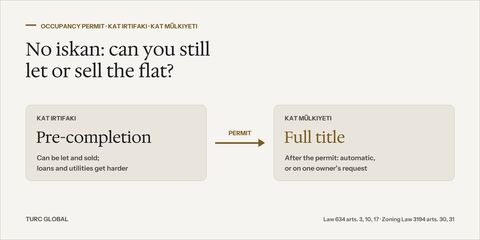
The permit is the hinge between the other two. Law 634 says kat irtifakı is converted into kat mülkiyeti on the basis of the occupancy permit for the whole building (article 3). No permit, no conversion: the deed stays at kat irtifakı, even if people have lived in the building for twenty years.
That is also why kat irtifakı on its own tells you little. In a new project it is normal: the building is still going up. In an older building it almost always means the permit was never issued, or was issued but the deed was never converted.
How to check where your flat stands
The title type. In practice the deed itself names it: kat irtifakı or kat mülkiyeti. Deeds issued long ago can be out of date, so the reliable source is a current land registry record (tapu kayıt örneği), which a representative or a Turkish lawyer can order for you. The same record shows annotations, mortgages and any urban transformation note.
The permit. The occupancy permit is issued by the municipality's zoning department, which can confirm whether one exists for your building and for which parts. The building's management often has a copy. If the deed says kat mülkiyeti, a permit was in place when it was converted.
Do this before you list the flat, not after a buyer's appraiser finds it. It is one of the delays we see most in sales, as set out in the costly mistakes owners make when selling.
Why a finished building still has no permit
The municipality issues the permit only after checking that the building matches its construction permit and plans, and is technically safe to use (Law 3194, article 30). Common reasons a lived-in building never got one:
- The building differs from its plans: an extra floor, enclosed balconies, a converted roof or basement.
- Unfinished work in the common areas, the shelter or the parking that the contractor left behind.
- One owner's alterations that put the whole building out of line with the approved project.
- Nobody applied, because the building was already occupied and the flats were already sold.
The law also allows a permit for completed parts of a building. And under article 31, units that have their own permit can receive utilities even when the rest of the building does not.
The permit exists, but the deed was never converted
This is the easy case. Since a 2021 amendment to Law 634 (article 10), once the municipality uploads the permit to the national address system, the land registry changes the property type and converts kat irtifakı to kat mülkiyeti by itself, free of the registry's service fee. For permits from before that system, conversion still needs a request, and article 3 says the request of one co-owner is enough. You do not need your neighbours' signatures.
Letting with kat irtifakı or without a permit
The lease is valid either way. The Code of Obligations (Law 6098, article 301) asks the landlord to hand over a flat fit for the agreed use and to keep it so. It says nothing about permits. What makes a flat unfit in practice is the utilities.
Electricity and water. Article 31 of the Zoning Law bars buildings without a permit from electricity, water and sewer services until the permit is issued. Two exceptions matter:
- Temporary subscriptions for buildings that had a construction permit by 1 July 2022 and are already served by roads, water or other infrastructure (temporary article 11). For buildings made before 31 December 2021 the construction-permit condition does not apply.
- Buildings holding the 2018 registration certificate (see below), which may get temporary water, electricity and gas.
A temporary subscription gives no acquired right: the law says it is cancelled if the municipality asks the distributor to cut it. In practice gas follows the distributor's own rules, so ask before promising a tenant heating.
What to do before you let:
- Check the subscriptions that exist and whether they are permanent or temporary. A tenant who cannot open an account in their own name is a problem in week one.
- Say so in the lease if the subscriptions are temporary. A tenant who later loses electricity can claim a defect against the landlord (articles 304 and 305).
- Expect the same building rules. Where the building is complete and two thirds of the flats are in use, Law 634's management rules apply even without full title (article 17). Aidat (the building's monthly service charge), meetings and votes work as in any building, as covered in building owners' meetings from abroad.
For the rest of the letting process, see renting out your property in Istanbul.
Selling with kat irtifakı or without a permit
Kat irtifakı is a registered right, and the land registry transfers it like any other. A cash buyer can complete the same way as for a fully titled flat.
What changes is the buyer pool. In practice a lender's appraisal records the title type and whether there is a permit, and a missing permit can lower the loan or rule it out. Buyers who need a mortgage then fall away, and the flat competes for cash buyers only. That usually costs time, price, or both. How much depends on the building and the district; it is one of the criteria we weigh in what your Istanbul property is really worth.
Three things keep a sale on track:
- Put the facts in the file from the start: the current registry record, a copy of the permit or the reason there is none, and the state of the subscriptions.
- Price for the buyers you can reach. Pricing as if the flat had full title, then cutting after the first bank refusal, is the slow route.
- If the permit exists, convert first. A request at the land registry before listing turns a hard question into a clean deed.
The rest of the sale, including the power of attorney and taxes, is in selling property in Turkey from abroad.
The 2018 building registration certificate
Many Istanbul buildings without a permit hold a yapı kayıt belgesi, the certificate from the 2018 zoning amnesty (Law 3194, temporary article 16). It covered buildings made before 2018 without a permit or against one. Applications were due in 2018, with a possible extension of at most a year, so they closed long ago.
What it does:
- Allows temporary water, electricity and gas connections.
- With every owner's consent, allows conversion to kat mülkiyeti without a permit, at double the registration fee.
What it does not do: it is not an occupancy permit, it says nothing about earthquake safety, and it lasts only until the building is rebuilt or enters urban transformation. If your building is heading that way, see our guide to urban transformation.
What you can do from abroad
- Order the registry record through a representative or lawyer, to see the title type and annotations.
- Ask the municipality whether a permit exists for the building, or for your part of it, and if not, why.
- If the permit exists, have your representative ask the land registry to convert the deed. One owner's request is enough.
- If it does not, raise it with the management and the other owners. The fix is building-level: the municipality inspects the whole building, and an architect usually prepares the application. The law gives the municipality 30 days to decide once it is filed.
- Plan the flat around the answer: temporary or permanent subscriptions for a tenant, cash-buyer pricing for a sale.
Steps 1 and 3 need a power of attorney that covers land registry work. How to make one from abroad is explained in the selling guide linked above.
What we do, and what we do not do
We do not apply for permits, convert deeds or give legal opinions; the municipality, the land registry, architects and lawyers do that. What we do is everything around the flat: we check its paperwork before it goes on the market, keep it let and looked after, tell you what it is worth with its title as it stands, and sell it when you decide to. The rules on this page were checked on 25 November 2026.