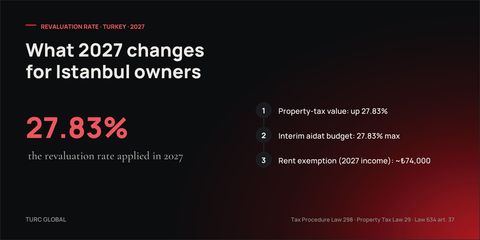
On 3 November 2026 TurkStat published October's producer prices, and with them the number that resets a long list of Turkish taxes, fees and fines for the coming year: the revaluation rate, 27.83%.
For a tourist it means a dearer passport. For someone who owns a flat in Istanbul and lives abroad, it decides how much the 2027 property-tax bill goes up, how far a building manager can push the aidat without a vote, and how much of next year's rent is tax-free. None of it needs you in Turkey, but all of it is worth knowing before the bills arrive.
This page was written two days after the figure appeared. The Ministry of Treasury and Finance announces the rate formally in a Tax Procedure Law (VUK) communiqué in the Official Gazette, and last year's came on 27 November. On 5 November 2026 this year's had not been published. The rate is not a policy choice: the law defines it as the average rise in the domestic producer price index over the twelve months to October (VUK article mükerrer 298/B), so the communiqué only confirms what the data already says.
What the revaluation rate is, and what it is not
Turkish tax law contains hundreds of fixed amounts: exemptions, thresholds, fees, minimum fines. Rather than amend each one every year, the law says they rise by the revaluation rate (yeniden değerleme oranı). The rate announced in November 2026 is officially "the rate for 2026" and it is applied to amounts used in 2027, which is why the press calls it the 2027 rate. Both mean the same 27.83%.
What it is not: the rent increase cap. The ceiling on rent increases at renewal is the twelve-month average of consumer prices (CPI), a different TurkStat series under a different law. It changes every month and is covered in the legal rent increase cap. If a tenant or a building manager quotes 27.83% at you for the rent, they have the wrong number.
1. Property tax: the 2027 value rises by the full 27.83%
This is the effect that costs owners the most, and the one most news reports get wrong.
Article 29 of the Property Tax Law says that in each year without a general reassessment, the tax value is the previous year's value increased by the revaluation rate set for that year. Until December 2025 the words were "by half of the revaluation rate". Law 7566 deleted "half of". The 2026 values came from the general reassessment, with the cap explained in Turkey's 2026 property tax reassessment. 2027 is the first year the new formula bites.
So the 2027 value is the 2026 value plus 27.83%, and the tax rises in the same proportion because the rate (0.2% a year for a home in Istanbul) does not change.
| 2026 | 2027 | |
|---|---|---|
| Property-tax value of the flat | ₺4,000,000 | ₺5,113,000 |
| Residential property tax at 0.2% | ₺8,000 | ₺10,226 |
| Plus 10% cultural-property contribution | ₺800 | ₺1,023 |
| Total for the year | ₺8,800 | ₺11,249 |
The 2027 value is rounded down to the thousand, as the law requires. Your own 2026 value is on your 2026 property-tax statement in the district municipality's online service.
You will see 13.92% in some reports. That is half of 27.83%, the old rule. It is still the rule for one thing: the thresholds of the separate valuable housing tax, which article 44 raises by half the rate.
One caveat. The same article lets the President reduce the increase, down to zero, and to do it differently for different groups of municipalities. No such decision has been announced. If one is published before the bills go out, we will update this page.
What it means for an owner abroad. The first instalment is due March to May 2027 and the second in November, as every year; how to pay without a Turkish bank card is in how to pay property tax from abroad. If your tenant's lease makes them pay the property tax, which is unusual but happens, expect the conversation.
2. Valuable housing tax: values rise faster than the threshold
Homes whose building tax value passes a threshold pay a second, separate tax. For 2026 the threshold is ₺17,711,000. Under article 44 it rises each year by half the revaluation rate, so by 13.915% for 2027. Our arithmetic gives about ₺20.2 million; the Revenue Administration publishes the exact figure at the end of December, and the President may raise the increase up to the full rate.
The point for an owner of a large or central flat: tax values now rise by 27.83% while the threshold rises by about 13.9%. A home just under the line in 2026 can cross it in 2027 without anyone revaluing anything. The bands and rates are in property tax in Turkey: an owner's guide.
3. Aidat: 27.83% is the ceiling on an interim budget
Since Law 7579 came into force on 22 May 2026, the budget that sets your monthly aidat must be approved by the owners' meeting. Where a budget is already in force, the manager's interim budget for the new year can rise by no more than the revaluation rate "for the previous year" (Condominium Law article 37, last paragraph). For budgets in 2027, that is 27.83%, up from the 25.49% that applied in 2026.
In money: an aidat of ₺4,000 a month under the current budget can go to at most ₺5,113 under an interim budget from January 2027. More than that needs a vote of the owners' meeting.
The cap is a ceiling, not a target. A manager who raises every budget by exactly 27.83% is using the law's maximum, and the January or February meeting is where owners can ask for the cost lines behind it. How to vote from abroad by proxy, and how to challenge a decision, is in the building owners' meeting guide.
4. Rental income: the exemption for 2027 income moves to about ₺74,000
A slice of residential rent is free of income tax each year (Income Tax Law article 21). The amount for 2026 rent, declared in March 2027, is already fixed at ₺58,000. The new rate moves the amount for 2027 rent, declared in March 2028.
The law (article mükerrer 123) raises it by the revaluation rate and drops fractions of up to 5%. ₺58,000 plus 27.83% is ₺74,141, which points to about ₺74,000. That is our arithmetic, not an announcement: the figure comes in a communiqué normally published on 31 December, and the President can move it by up to half either way. The income tax brackets rise by the same rule.
Two things have not changed. The exemption is lost entirely if rent above it is not declared or is under-declared. And rent should arrive through a bank: collecting rent in cash carries its own fine, whose minimum amounts are also raised every year by this rate. The whole calculation is in rental income tax in Turkey.
5. Selling or inheriting: the property-tax value is a floor
The property-tax value matters beyond the yearly bill. The price declared at the land registry on a sale should not be below it, and inheritance tax is assessed on it for the year of the death. Both move up 27.83% on 1 January 2027.
For most Istanbul flats the 2026 tax value is still well below the market price, so a genuine sale price clears it easily, and the real question is the one in the declared-price penalty. For heirs, the higher 2027 value means a higher taxable base for a death in 2027 than for one in 2026; the deadlines and exemptions are in inheriting property in Turkey as a foreign heir.
What is not decided yet
- The communiqué itself. Due in the Official Gazette in late November. The figure is set by the data; the communiqué makes it official.
- The exact 2027 amounts. Rental exemption, valuable housing threshold, income tax brackets and minimum fines come in separate communiqués, normally on 31 December.
- Any presidential decision lowering the property-tax increase. None announced on 5 November 2026.
We track every rule that affects an owner abroad, with its status and source, in the rules tracker for foreign owners. This one is there from today, and we will update it when the communiqué is published.
What we do, and what we do not do
We do not file tax returns or give tax advice; a Turkish accountant (mali müşavir) does. What we do for owners abroad is the part around the bills: we keep the flat let and looked after, tell you what it is worth, and sell it when you decide to. The figures and rules on this page were checked on 5 November 2026.